Which Metal Roof Color Is the Most Energy Efficient in Florida?
Tania gets this question a lot, usually right after someone has looked at the color chart and fallen for a dark one. The short answer is that lighter colors run cooler, and the honest answer is longer than that, because a modern metal finish, the attic under it, and the way the panel is built all change how much the color matters.
Two Numbers Decide How Hot a Roof Gets
Every roof surface has two properties that matter in the sun. The first is solar reflectance, the share of sunlight the surface bounces back instead of soaking up. The second is thermal emittance, how readily the surface lets go of the heat it does absorb. The Cool Roof Rating Council, which rates roofing products, scores both on a scale from zero to one, and a roof it calls cool needs a high number on both.
Bare metal is the odd one out. Polished aluminum and unpainted Galvalume reflect a lot of sunlight but hold onto heat instead of radiating it away, so a shiny roof can sit hotter than you would guess in the late afternoon. A painted panel fixes that. The paint layer emits heat well, and the pigment in the paint sets the reflectance. That is why the color question is really a paint question, and why a factory finish beats a bare panel for a house you live in.
The scale of the effect is real. The U.S. Department of Energy's Energy Saver page says a reflective roof can stay more than 50 degrees Fahrenheit cooler than a conventional dark roof on a sunny summer afternoon. Anyone who has walked across a black shingle roof in Palatka in July and then across a white metal one knows that number is not exaggerated.
Light Colors Win, and Not by a Little
The rule is simple: the closer a color is to white, the more sunlight it turns away. Whites, off-whites, light stones and light grays sit at the top. Mid tones such as a medium gray, a tan or a weathered copper sit in the middle. Charcoal, dark bronze, black and deep greens sit at the bottom.
Tri County Metals, the Florida manufacturer whose panels we install, names Polar White, Regal White, Ash Gray, Dove Gray, Light Stone and Sandstone as the most energy efficient colors on its charts, and that matches what we see on the roof. A Polar White 5V panel on a block house in Crescent City is the coolest roof we can put on a home in this county. The tradeoff is looks and upkeep: white shows dirt, pine pollen and the green film that grows on every north slope under live oaks, so it needs a rinse now and then to stay the color you paid for.
Cool Pigments: A Dark Panel Today Is Not a Dark Panel from 1995
The part most people have not heard is that color and heat are no longer welded together. Paint makers now use pigments that reflect the invisible near-infrared part of sunlight while still absorbing visible light, so a panel can look charcoal to your eye and still turn away a good share of the sun's energy.
Tri County Metals offers this in both of the finish systems we use. Core Defender, the silicone-modified polyester finish on exposed fastener panels such as Ultra Rib and 5V, comes in cool colors with solar reflective formulations that, per the manufacturer, reflect sunlight and bring down surface temperatures. Max Defender, the 70 percent PVDF finish built on Sherwin-Williams Fluropon, is the one Tri County Metals describes as the choice for hot and humid conditions, and it is what we put on most standing seam roofs. Both are backed by Tri County Metals' limited paint and finish warranty, registered with the manufacturer, not with us.
What this means for you: a cool-pigment charcoal will never match a white panel, but it lands far closer to it than the old dark roofs did, and it holds its reflectance longer because the PVDF resin resists chalking and fading in our UV. If you want a dark roof, ask for the cool version of the color and ask to see the reflectance numbers for it.
What Our Customers Have Actually Chosen
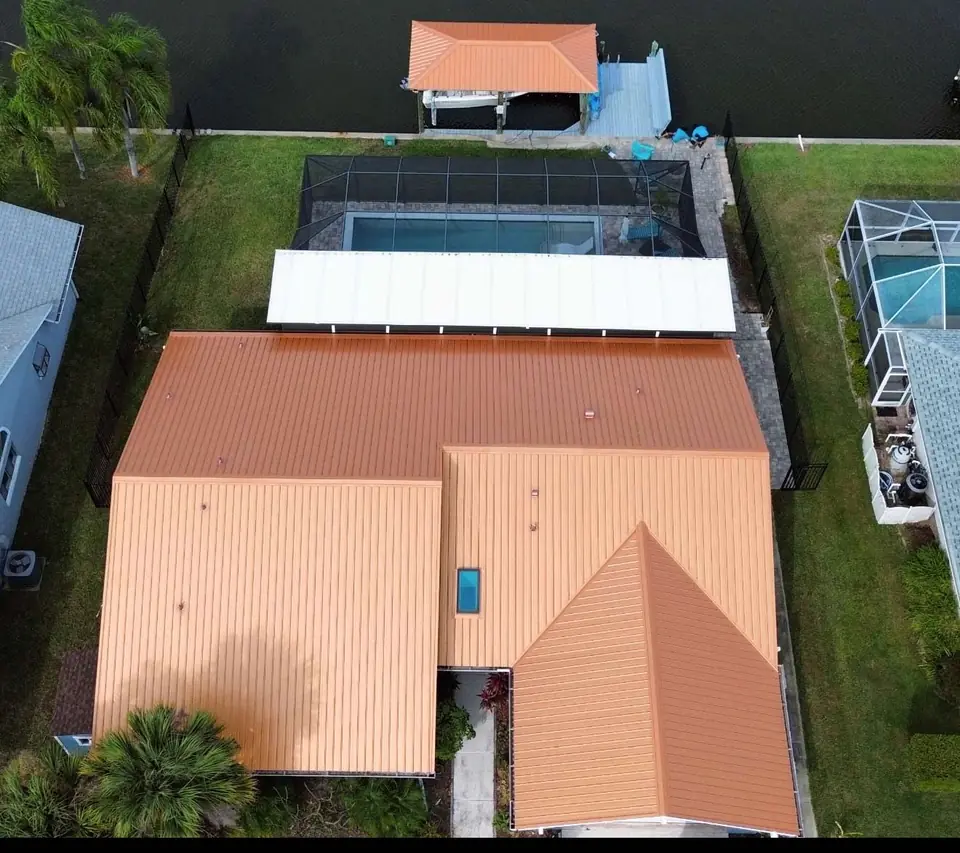
Look through our work and you will see the range. One family chose Copper Penny and told us in a review that they picked it for its classic beauty. Copper Penny is a mid-tone metallic. It reflects better than a dark brown and worse than a light gray, and on a well ventilated attic the difference from a lighter color is something you notice on the roof surface more than on the power bill.
Light gray is one of the most common picks we see, and for good reason. It sits near the top of the reflectance range, hides pollen and dust better than white, and looks right on nearly every block ranch and frame farmhouse between Satsuma and DeLand. Galvalume, the bare silver panel, is popular on barns, river houses and anyone who wants the old Florida look. It reflects well but emits poorly, so it is a fair choice for a detached building and a middling one for a bedroom ceiling.
We have put on a bright red roof for one customer and a royal blue standing seam for another. Both are saturated colors, which puts them in the warmer half of the chart, and both were made in cool-pigment finishes, which pulls them back. The owners picked the color they loved and got the attic right, which is the correct order.
Looks, HOAs and the Color the House Wants
A roof is a third of what you see from the street, so the color has to work with the walls. Bright white looks right on a coastal cottage in St. Augustine or Palm Coast and can look stark on a brown brick ranch in Ocala. Light gray and light stone go with almost everything. Galvalume wants a tin-roof house: board and batten, a wide porch, a farmhouse.
Homeowners associations in the newer subdivisions around Palm Coast, St. Johns County and Jacksonville often keep an approved color list, and some rule out bare metal or anything that reads as bright. Get the list before you fall in love with a color. If the HOA allows only earth tones, a cool-pigment tan or a light stone from the approved range will usually be the best you can do for heat.
The Attic Is the Other Half of the Answer
The panel keeps sun off the deck, but the attic decides what reaches the ceiling. A roof that reflects well over an attic with no ridge vent, blocked soffits and thin insulation will still pour heat into the bedrooms by four in the afternoon. A mid-tone roof over an attic that breathes, with a ridge vent or off-ridge vents matched to open soffit vents and insulation to current code, will outperform it.
That is why a metal roof from us starts with a look at the attic during the inspection. Ventilation is cheap to fix while the old roof is off and expensive to fix later. Color is the part you get to choose, and it matters, but it is one of three things.
Frequently Asked Questions
A bright white in a rated cool finish, with a light gray or light stone close behind. Tri County Metals names Polar White, Regal White, Ash Gray, Dove Gray, Light Stone and Sandstone as the most energy efficient colors on its charts. The catch is upkeep: white shows pollen and algae faster than gray, so plan on rinsing it now and then.
Not if it is a cool-pigment color in a PVDF or solar reflective finish and the attic is ventilated properly. Modern dark colors reflect much of the near-infrared sunlight that old dark paints absorbed, so a cool charcoal sits far closer to a light color than it used to. Pick the color you can live with for decades, then get the attic right.
It should lower the heat load on the attic, and most customers tell us the upstairs feels different in August. How much shows up on the bill depends on your insulation, ventilation, ductwork and how you run the thermostat, so we do not quote a percentage. The attic under your roof decides your number.
Talk Through the Color Chart With Us
Bring the color you like and the HOA list if you have one. Juan will look at the attic, the exposure and the house, and tell you which colors make sense and which one he would pick. Call (386) 559-2169 or use the contact page.